
The Forgotten Lesson of Change Management

Updated: Mar 11
How to Help People Feel More Comfortable with Change

The human resources director was exasperated. The transition plan had already been developed and revised 100 times, yet the company president wanted to meet with each team separately to get their input.
The company had been the lead operator on a very productive oil field for many years, and now it was handing over control to its joint venture partner. The transition would inevitably lead to major changes, and far fewer colleagues than they had now. Surely this could simply be communicated – in a compassionate way, of course – more efficiently than meeting with each team individually, the HR director thought.
What he came to discover was that not all change is created equally, and recognizing different types of change can have a major influence in how we lead others through it.
So, what kinds of change might we encounter in the workplace?
Colleagues come and go. New snacks emerge in vending machines. Customer demands evolve. Suppliers get switched out.
We might call this chronic change. It's not bad, and it might add up to a substantial change, but it's not immediately disruptive. When I became a journalist, my first job was at a newspaper, and we used computers that could show only brown type on a black screen. Over time, we got fancier computers, mobile phones and digital cameras, which together added up to a very different way of working, but separately were no big deal.
Change Leadership Expert Graham Norris
Graham is a much sought-after international speaker who is often booked up months in advance due to his unique insights. Please get in touch with Graham as early as you can in your planning, so you can secure his presence at your event and get his input into your planning process.
However, that newspaper doesn't exist anymore. I wasn't there when it happened, but I can imagine printing the final edition of the newspaper would have been an emotional experience for those involved. This kind of major, high-impact event could be called acute change, and includes corporate restructurings, war, digital transformations, and new ownership. Rather than creeping up on you, it hits you in the face.
Yet this isn't the only, or even most important, way of looking at change.
Don't Ask, Don't Tell
The regional president of that oil company was drawing on research first conducted 80 years ago at a textile factory in Virginia. Harwood Manufacturing opened a facility there in the late 1930s, but struggled to achieve the same levels of productivity as at it's previous location. So they hired organizational psychologists to find out why.
One of the most eye-opening pieces of research was on how change was handled. In this experiment, there were three groups of workers. The first was told what was going to change, and asked if they had any questions. A second group could elect representatives to discuss how to implement the changes with the management, and a third group was consulted throughout the change planning process.
The first group experienced a sustained 20 percent drop in productivity. The second group suffered an initial productivity drop but then recovered. The third group enjoyed a sustained increase in productivity of 15 percent.
It's empowering to feel you're changing things. And disempowering to feel you're being changed.
This leads us to an important distinction in how we perceive change: Am I doing the changing, or is it being done to me?
Are You Talking to Me?
Some change is clearly outside of our control: The weather, geopolitics (for most of us), technological developments. Some change is mostly within our control, such as finding a new job, taking a different commute or getting a new set of clothes.
Then there is change at our fingertips. It is mostly out of our reach, unless we really stretch for it or someone nudges it within our grasp. It's the kind of change they were studying at Harwood Manufacturing, and the kind of change that the oil company president was trying to create at his company.
Yet how often are you consulted about change in your company?
Of course, it would be overwhelming to have a vote on every change, so the question becomes what kinds of change people should be asked about.
It seems to make sense that the bigger the change, the more input we should get from the common worker, who wants more influence over it. This make give us a "consultation curve" looking a bit like this:
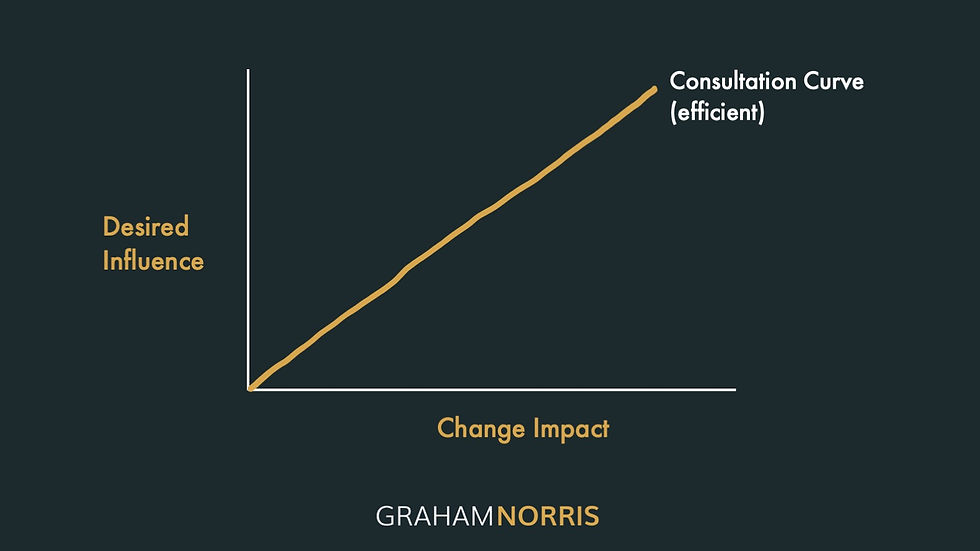
However, in reality people care about much more than this. The color of the walls, the snacks in the kitchen and (dare I go here) the temperature in the office can all be the subject of intense debate and entrenched opinions. So from the cubicle's perspective, the consultation curve looks more like this:

Yet this isn't what they get. In fact, what they get is quite the opposite. The bigger the change, the less likely they are to get their say. The corporate consultation curve looks more like this:

No wonder, then, that change management and transformation initiatives continue to be such headaches for companies. It's like the Harwood experiments never happened.
Change We Can Believe In
The lessons from all this are:
It's useful to understand what kind of change you're dealing with when leading people through it.
Change can be disruptive, but it can also be empowering.
While it takes more upfront effort, helping people feel in control of what's happening to them does wonders for long-term motivation.
Transparency has been a corporate buzzword for many years, but it's not enough simply to tell people things you feel are a bit secret. If you want your team along for the ride with you, you need to involve them as much as possible in the decisions about where you're heading.
Want to be more futurist? Sign up for The DIY Futurist.

